2026 cohorts are now open across all programs · See the programs
Professional certificationCAIF-01
Certified AI Foundations
Eight weeks · Live weekend classes · Code every week
An intensive, practical introduction to programming, data, mathematics, software and artificial intelligence — for people who want the technical capability to go further into AI, not another course on how to prompt it.
8 wk
Program length
16
Live sessions
6
Foundation modules
$499
Full programme


Live class — writing and debugging code
Programme overview
Foundations first
AI is changing how software is built, how businesses operate and how people solve problems. Getting beyond simply using AI takes foundations — six of them, built in the order they depend on each other.
How computers think
Problem decomposition, algorithms and structured reasoning before any syntax.
How programmers think
Python written every week, not watched — variables through to object orientation.
How data works
NumPy, Pandas and Matplotlib against real datasets you load, clean and analyse.
Mathematical intuition
Algebra, statistics, linear algebra and calculus, at the depth AI actually needs.
How software works
The command line, Git, APIs, HTTP and JSON — the plumbing under every AI system.
How AI systems are built
Machine learning, deep learning, LLMs, training, inference and their limits.

Faculty-led live instruction
Audience
Who is this for?
The programme is for people who want to move beyond using AI tools and begin understanding how AI works and how to build with it.
Coming to AI for the first time
- Students exploring AI as a career
- Graduates from technical or non-technical disciplines
- AI enthusiasts who want to understand what happens behind the interface
- Anyone who wants a structured introduction before more advanced AI study
Already working, moving across
- Software and technology professionals entering AI
- Professionals looking to transition into AI
- Entrepreneurs and builders who want stronger technical foundations
- Managers who need to judge AI work rather than only commission it
You do not need to be an AI expert, and you do not need extensive programming experience. What the eight weeks ask for is curiosity, commitment, and the willingness to write code every week.
Approach
What makes it different?
There are thousands of courses that teach people how to use AI. This one teaches the foundations underneath it. Instead of beginning with prompt engineering and AI tools, you begin at the bottom:
- 01How computers think
- 02How programmers think
- 03How software works
- 04How data works
- 05How models learn
- 06How AI systems are built
That progression is the point. Each layer is what the next one is made of, so when large language models arrive there is already something underneath them for the explanation to attach to — rather than a description you have to take on trust.
Recognition
Best Places to Study AI
Tech AI Magazine has recognized the Heisenberg Institute for AI and Quantum Computing in its Best Places to Study AI listing.
What you get
Why Heisenberg
What the Institute puts behind every candidate it admits.
Global faculty and experts
Learn from leading AI researchers and industry experts across multiple domains.
Hands-on practice
Eight weeks that end in a working AI system, on a problem you choose, that you designed and built yourself.
Job assistance
Resume building, mock interviews, interview preparation, career guidance, and job connections and updates.
Flexible payment options
Instalments and flexible payment plans — talk to the admissions team.
By the numbers
The Institute in numbers
|ψ⟩ = α|0⟩ + β|1⟩
5
Programmes
Five certifications, from a two-month foundation to two six-month flagships.
16
Live sessions
Six hours of faculty-led instruction every week, across eight weeks.
22
Faculty
Eight lead and fourteen visiting practitioners who shape the curriculum and mentor cohorts.
8
Weekly assignments
Code written and returned with feedback, every week of the programme.
24/7
Learning access
Always-available platform and a community of peers, mentors, and alumni.
Applied training
You write the code — every week
This is not a watch-someone-code course. Every module ends in work you produce, and the programme ends in a system you designed and built yourself rather than in a multiple-choice examination.
Weekly coding assignments — Python written and returned with feedback, from week one through week eight.
Real datasets — Load, clean, explore, transform, analyse and visualise data that was not tidied for you.
A final AI system — The eight weeks end in one system of your own, on a problem you choose.


The final project
Build your own AI system
The eight weeks end in one piece of work: a full AI system, on a problem you choose, that you designed and built yourself. Five things it has to do —
- Perceive — take in information from data, documents, APIs or other inputs.
- Reason — work out from that information what needs to happen.
- Act — execute code, call a tool, or carry out a defined action.
- Evaluate — judge whether what it produced is correct or useful.
- Respond — communicate the result back to the person who asked.
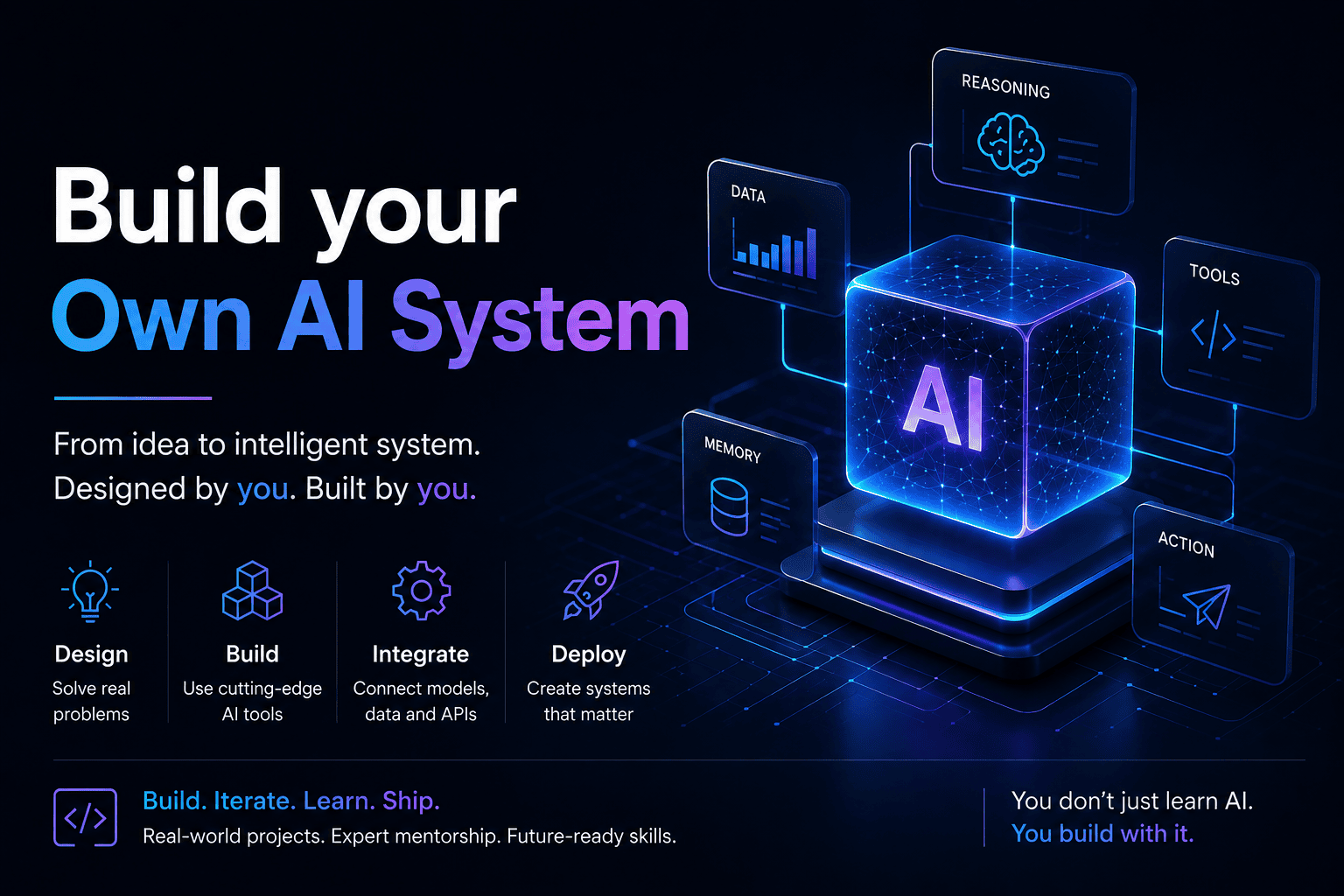
It is the difference between “I use AI” and “I can build something with AI” — and it is what the credential is awarded against.
Certification
A credential earned by building, not by examination
Successful completion confers the Certified AI Foundations credential from the Heisenberg Institute, on completing all eight weeks and the final AI system project.
Certified AI Foundations (CAIF)
Validates working ability in Python, data, the mathematics of AI and how AI systems are built.
A working AI system
The final project itself — designed, built and evaluated by you, and yours to show.
A route into the advanced programmes
The foundation CPAI and CPAA build on — and the recommended next step after CAIF.
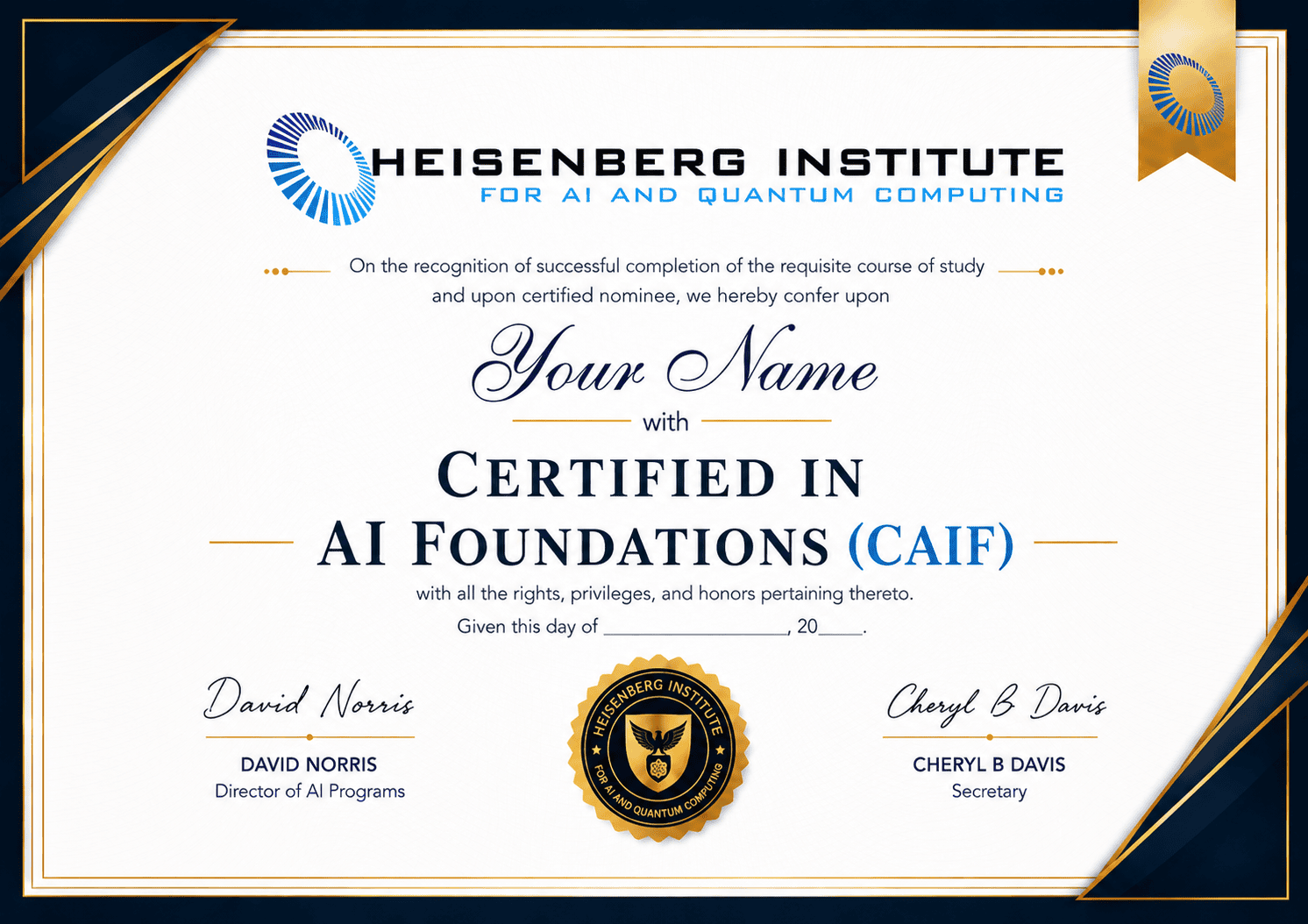
Intake schedule
Monthly cohort commencement
The programme admits a cohort every month. Applying early is the surest way to secure the cohort you want.
All classes are held online only. Live sessions run on Saturday and Sunday, 1:30–4:30 PM GMT.
Cohort
Application closes
Program starts
Status
CohortSeptember 2026 Cohort
Application closesSeptember 1, 2026
Program startsSeptember 25, 2026
StatusClosed
CohortOctober 2026 Cohort
Application closesOctober 1, 2026
Program startsOctober 25, 2026
StatusOpen
CohortNovember 2026 Cohort
Application closesNovember 1, 2026
Program startsNovember 25, 2026
StatusUpcoming
CohortDecember 2026 Cohort
Application closesDecember 1, 2026
Program startsDecember 25, 2026
StatusUpcoming
CohortJanuary 2027 Cohort
Application closesJanuary 1, 2027
Program startsJanuary 25, 2027
StatusUpcoming
Programme fee
$499USD · full programme
Flexible payment options and corporate sponsorship support are available — contact the admissions team for details.
Bonus: the programme is delivered as live online classes on Saturdays and Sundays, 1:30–4:30 PM GMT, with recorded sessions for anything you miss.
Your fee includes
- Certified AI Foundations (CAIF) certification, awarded by the Heisenberg Institute for AI and Quantum Computing
- Sixteen live faculty-led sessions across eight weeks — six hours of instruction a week
- Weekly coding assignments returned with individual feedback
- The final project: an AI system you design and build yourself
Frequently asked questions
Before you apply
Do I need programming experience?
No. Week one starts at computational thinking and week two starts Python from syntax. You do need to be willing to write code every week — this is not a course you can complete by watching.
Do I need to be good at mathematics?
No. The objective is mathematical intuition, not proof: enough algebra, statistics, linear algebra and calculus to understand what an AI system is doing. School-level mathematics is the starting point.
Are classes held online or on campus?
Online only. Live classes run Saturday and Sunday, 1:30–4:30 PM GMT, with recorded sessions so a missed class does not cost you the week.
When do cohorts begin?
Cohorts commence every month. Applications close on the 1st and classes begin on the 25th. Applicants are encouraged to apply six to eight weeks ahead of the deadline.
How is the programme assessed?
On work you produce. Weekly coding assignments through the programme, and the final project — an AI system of your own, on a problem you choose. There is no multiple-choice examination.
What can I do after CAIF?
CAIF is designed as the foundation the advanced programmes build on. Certified Professional in AI (CPAI) and Certified Professional in Agentic AI (CPAA) are the intended next steps; AI Security (CAIS) and AI Governance (CAIG) are the specialist routes.
Are flexible payment options available?
Yes. Flexible payment plans and corporate sponsorship support are available — contact the admissions team for details.